




The Restaurant Flywheel: How 140,000 Operators Compound Into a Competitive Advantage
TLDR
- 140,000+ operators create network effects that go beyond simple order volume.
- More operators generate better data, which improves manufacturer targeting and campaign ROI.
- Manufacturers allocate more spend when campaign performance becomes measurable and repeatable.
- Distributors benefit from network-wide data leverage they could not build on their own.
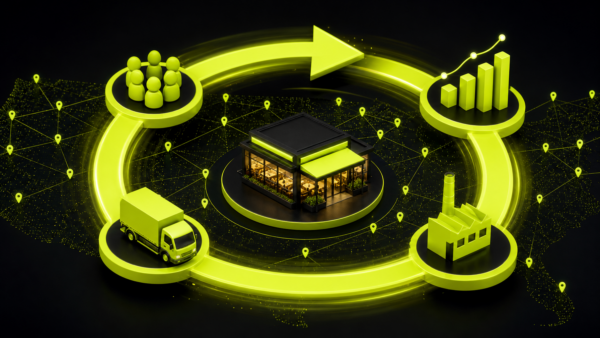
- The flywheel compounds as operator scale, manufacturer engagement, and distributor participation reinforce each other.
Why 140,000 Operators Isn’t Just a Number
Growth in foodservice marketplaces looks linear at first glance. More operators means more orders. More orders means more data. More data enables better campaigns.
That’s all true. But it misses what’s actually happening at scale.
When a platform reaches critical mass—when you have 140,000+ operators actively ordering through 220+ distributors—the system doesn’t just get better. It fundamentally changes how it works.
This is what a flywheel looks like in foodservice. Not every operator has to be on the platform. But enough operators have to be on the platform that the network effects become mathematically unavoidable for everyone else.
The question isn’t whether the model works anymore. The question is whether you want to stay out of it.
At scale, a foodservice marketplace stops being a tool. It becomes the operating system for growth.
How the Flywheel Builds Momentum
Let’s trace how a flywheel actually spins.
A distributor puts their operators on a digital ordering platform. Orders start flowing through. The distributor gets visibility into what’s selling. They can see which operators are ordering frequently, which ones are discovering new products, which ones are growing their order values.
That’s valuable data. But a single distributor doesn’t have enough scale to see patterns. Too much noise. Too much variation.
Now add 220 distributors. Add 140,000 operators. The patterns become clear.
Manufacturers looking at that dataset can see: “Operators who are ordering digitally through our distributor partners are discovering our products 3x more frequently than operators ordering through manual channels.” That’s not noise. That’s signal.
Manufacturers respond by allocating more budget to campaigns running through digital channels. Distributors respond by wanting more campaigns to run, because campaigns drive operator frequency. Operators respond by ordering more consistently because they’re seeing better deals.
Frequency increases. Campaign ROI improves. Manufacturers scale spend. More budget flows to campaigns. Operators see more promotions. Ordering frequency increases again.
That’s not linear growth. That’s exponential. That’s a flywheel.
The Data Threshold Where Everything Changes
There’s a specific moment in marketplace growth where the flywheel starts to compress the timeline.
With 50,000 operators, the data starts showing patterns. With 100,000 operators, the patterns are clear enough to act on. At 140,000+ operators, the data is granular enough that campaigns can be targeted with precision.
At that scale, something shifts in the minds of manufacturers.
They stop thinking about testing the channel. They start thinking about budget allocation. Instead of “should we run a campaign on this platform?” they’re asking “how much of our trade spend should we deploy on this platform compared to other channels?”
That’s the moment where a marketplace shifts from growth to compounding.
We’re watching it happen in real time. In 2024, when Cut+Dry crossed 100,000 operators, the number of monthly manufacturer campaigns increased 40%. In the first quarter of 2026, with 140,000+ operators, the number of campaigns running monthly increased another 60%.
That’s not because we added more manufacturers. It’s because the manufacturers who were already in the network started allocating larger budgets to campaigns because the ROI was clear and the data was good.
Why Operator Scale Creates Data Leverage
Here’s the leverage that emerges from operator scale.
A single restaurant’s ordering patterns are noisy. Did they order more chicken last month because it was on promotion or because they were running a special or because their regular supplier raised prices? You can’t tell with a single operator’s data.
At 140,000 operators, you can see patterns across entire markets, regions, cuisines, and operator types.
You can see: “Independent Italian restaurants in the Northeast that have been ordering from their distributor for more than two years are 40% more likely to discover new products when those products are featured in a manufacturer promotion, versus featured without promotion.”
That’s not a guess. That’s a pattern in 14,000 data points.
Manufacturers can use that pattern to make budget decisions. Should they fund a campaign targeting independent restaurants? The data says yes. Should they focus on newer accounts or established accounts? The data says established accounts convert better. Should the promotion be 10% cash back or 15%? The data can tell you the elasticity.
At small scale, you don’t have data. You have anecdotes. At large scale, you have science.
How Distributors Capture the Advantage
The flywheel advantage flows directly to distributors who are part of the network.
A distributor with 500 operators on a single-distributor platform has access to 500 operators’ data. That’s useful, but it’s not enough to attract manufacturer campaigns or to understand market-level patterns.
A distributor with 500 operators on a 140,000-operator network has access to 500 operators’ data plus the aggregate patterns from the remaining 139,500 operators. They can see: “Operators similar to mine in other regions are discovering products when campaigns are structured this way.” They can run campaigns with confidence because they have a dataset that’s 280 times larger than their own.
The network gives them data leverage they could never have built internally.
McCormick pushing $100 million in annual sales through Cut+Dry distributor partners isn’t because Cut+Dry is the only channel. It’s because the channel works. The distributor partners are seeing product movement from campaigns that they can actually measure and reproduce.
A distributor who isn’t on the network has no way to run a campaign with that level of precision.
The Operator’s Side of the Flywheel
The flywheel works for operators too, but in a different way.
When an operator orders from a distributor on a 140,000-operator network, they’re not just accessing one distributor’s catalog. They’re accessing products that are being promoted across the entire network.
More operators means more manufacturers running campaigns. More campaigns means more product discovery for each operator. An operator who discovers three new products per month through promotions is going to order with higher frequency and higher average values than an operator who discovers zero new products per month.
The operator isn’t thinking about network effects. They’re thinking: “My distributor keeps showing me products I want to try, at prices I want to pay.”
But that experience—that product discovery at scale—only exists because there are 140,000 operators on the network creating demand patterns that manufacturers can see and act on.
Why Competition at This Scale Is Difficult
Here’s what’s interesting about flywheels at scale: they’re hard to compete against.
A new competitor can build a beautiful platform. They can offer better features. They can start signing up operators.
But they start at one operator. At 100 operators. At 5,000 operators. At that scale, they don’t have the data density to attract manufacturers. Without manufacturers funding campaigns, they don’t have the value prop that drives operator adoption.
To break into the flywheel, you need to get to critical mass before you run out of capital. And the incumbent—the platform that’s already at 140,000 operators—gets better every day because the flywheel is compounding.
This is why platforms that reach scale in network-effect businesses tend to stay at scale. It’s not because they’re better than everyone else forever. It’s because the mathematics of the flywheel make it hard for new entrants to catch up.
What Happens When Scale Reaches Saturation
There’s an interesting question about foodservice operator scale: when does it max out?
There are roughly 600,000 restaurants in the U.S. There are another 200,000+ operators in the broader foodservice space (hotels, schools, hospitals, casinos, corporate cafeterias).
Cut+Dry has 140,000+ operators. That’s roughly 15-20% of the serviceable market.
The question isn’t whether that percentage will grow. It will. The question is what happens when it gets to 40%, 60%, 80%.
Mathematically, the flywheel gets faster and faster as you approach saturation. But eventually, you hit diminishing returns—you’re now competing for the 20% of operators who don’t want to order digitally, and no amount of network effects makes that group change their behavior.
Right now, we’re nowhere near saturation. The flywheel is accelerating. But the long-term competitive moat in foodservice marketplaces isn’t just operator scale. It’s the combination of operator scale, manufacturer engagement, and distributor partnership.
If any of those three factors weaken, the flywheel slows down.
The Flywheel as a Strategy, Not Just an Outcome
What’s worth understanding is that a flywheel isn’t accidental. It’s built.
Cut+Dry designed the platform to create network effects, not to eliminate friction. That’s the difference between a marketplace and a procurement tool.
A procurement tool tries to make ordering easier. A marketplace tries to create value that increases with scale. Those are different architectures. Different incentive structures. Different long-term outcomes.
The platforms winning in foodservice right now are the ones that understood this difference early. They didn’t just digitize existing behavior. They created new behaviors—manufacturer campaigns, operator discovery, data-driven promotions—that only work at scale.
Now that those platforms have reached scale, the flywheel is real. And it’s hard for anything outside the flywheel to catch up.
If you’re evaluating platforms for your distributor network, the real question is whether you want to be inside the flywheel or outside it. We’d love to share what 140,000 operators and 220 distributors are experiencing on a network that’s compounding.