




13.9x ROI: What Manufacturer Influence Actually Costs and Returns
TLDR
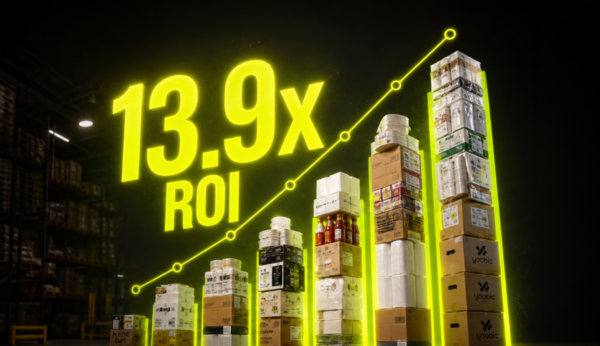
- A $50K campaign can drive ~$700K in attributable sales—about 13.9x ROI.
- Targeted cashback incentives influence operator behavior at the moment of purchase.
- Attribution enables real measurement, unlike traditional trade spend.
- Traditional promotions average ~2–3x ROI vs. 13.9x with measurable campaigns.
- Manufacturers using attribution are gaining a compounding competitive advantage.
The Math That Makes Sense
When you run a manufacturer-funded cashback campaign for a specific product through a network of independent foodservice distributors, the numbers look like this:
You start with $50,000 in marketing budget. You identify a product that’s underperforming in a specific geography or operator segment. You fund a 30-day cashback program that puts a financial incentive in front of the right operators, through the distributors who carry your product, targeted at the exact moment when they’re placing orders.
Thirty days later, you measure the results. The campaign moved $700,000 in incremental sales across the network. Operators purchased more of the product. Distributors captured the volume. You see the purchase data transaction by transaction.
That’s $700,000 in attributable sales from a $50,000 investment. That’s 13.9x ROI. Every dollar spent returned fourteen dollars in sales.
This isn’t a projection or a modeled scenario. This is what independent data shows when you aggregate across hundreds of campaigns running through the Cut+Dry network of 220+ distributors and 140,000+ operators. It’s repeatable. It’s predictable. It’s the foundation of how modern manufacturer trade spend actually works when measurement is built into the model.
The manufacturers who understand this number are rewriting their entire trade spend strategy around it.
How the $50K Translates to $700K
The mechanics are straightforward, but understanding them matters if you’re going to evaluate this against your current trade spend ROI.
Your $50,000 budget funds a cashback incentive. Let’s say you offer two percent cashback on every unit purchased during the campaign window. An operator buys cases of your product, earns cashback on each transaction, and receives it immediately in their account with the distributor. No thresholds. No delayed rebate checks. No friction.
The incentive is targeted. You’re not funding a generic promotion that runs to every operator. You’re funding campaigns aimed at specific operator types in specific geographies where your product has the most upside. A fine dining group in the Southwest. Independent pizzerias in the Northeast. Hotel chains near major metropolitan areas. The targeting multiplies your effectiveness because you’re reaching the operators most likely to respond.
The distributor’s role is execution, not incremental sales effort. The program runs through their existing ordering platform. Their operators see the incentive when they’re already placing an order. There’s no push from the distributor sales team required. The campaign does the work. The operator makes a purchasing decision that benefits them. The distributor captures the volume.
The result is $700,000 in new product sales that wouldn’t have happened without the incentive. Some of that is existing operators buying more. Some of that is operators who weren’t buying your product trying it and adding it to regular orders. Some of that is operators increasing order frequency or basket size because they have a financial reason to stock your products.
All of it is incremental to what they were buying before.
The distributors in the network capture that volume at their normal margins. The operators get cashback that actually hits their account balance. You get the knowledge that your $50,000 investment created $700,000 in measurable sales.
That’s the math. It works because every party in the transaction is aligned.
When the incentive is immediate, the targeting is specific, and the attribution is precise, the multiplier shows up in the data every time.
Why This Beats Traditional Trade Spend
The ROI difference between manufacturer Influence campaigns and traditional trade promotions is enormous, and it matters because it changes how you should be allocating budgets.
In a traditional trade spend model, you fund a promotion through a distributor with limited visibility into execution. You get a rebate report at the end of the quarter. You have no way to know what portion of the sales attributable to the SKU came from your promotional funding versus organic demand. You might see that distributor sold more of your product that quarter, but you can’t separate signal from noise.
You guess at ROI. You assume a multiplier. You move to the next quarter and fund again because the alternative is admitting you have no idea what your trade spend creates.
With attribution-based campaigns, you have a different problem: too much visibility. You can see exactly what worked, what didn’t, which distributors executed well, which geographies responded, which operator types drove the most volume. You have to make decisions on data instead of assumptions.
The ROI difference is material. Traditional trade spend shows something like 2-3x return if you’re optimistic and if you make a lot of assumptions about causality. Influence campaigns with transaction-level attribution show 13.9x return. That’s not a slightly different approach. That’s a completely different category of effectiveness.
The reason is simple: traditional trade spend is an expense you hope contributes to revenue. Influence campaigns are a marketing channel you can measure, optimize, and prove. The difference between those two things is the difference between hope and accountability.
Scaling the Model Across Your Portfolio
The power of the 13.9x number becomes obvious when you think about portfolio impact.
If you have $5 million in total foodservice trade spend this year, and you could shift even half of it to campaigns with measured ROI, that’s $2.5 million with a 13.9x multiplier. That’s $34.75 million in attributable sales. The other $2.5 million in traditional trade spend might deliver $5-7.5 million in sales if you’re generous with assumptions.
You’re looking at the difference between $40 million and $12 million in total incremental revenue from the same budget. That’s not a rounding error. That’s a massive strategic lever.
And that’s assuming the ROI stays constant as you scale, which the data suggests it does. The 13.9x multiplier holds across different product categories, different geographies, different operator types, and different distributor networks. It’s not a one-off result from a perfect campaign. It’s what happens when the model is built right.
What Makes Attribution the Multiplier
The reason Influence campaigns deliver so much higher ROI than traditional promotions is that attribution lets you optimize every step of the process.
You see a campaign that didn’t perform as expected. You know why. You can adjust the targeting, the incentive level, the timing, the distributor mix. You run the next iteration and measure again. You’re compounding small improvements into significantly better results over time.
You can’t do that with traditional trade spend. Without attribution, you’re flying blind. You run the campaign, hope it worked, and maybe try something different next time based on a hunch.
Visibility creates opportunity. Measurement creates optimization. And optimization at scale is what turns a 3x ROI into a 13.9x ROI.
This is also why the 13.9x number matters more than the marketing narrative around it. It’s not a celebrity endorsement or a celebrity manufacturer running an exceptional campaign. It’s the aggregate result across hundreds of campaigns with different products, different distributors, different operator segments, all running through the same measurement infrastructure. The consistency of the number is what proves the model works.
The Competitive Implication
The manufacturers winning in foodservice today are the ones running these campaigns. McCormick is moving $100 million in annual sales through independent distributors, much of it through Influence campaigns. They’re not competing on traditional trade spend anymore. They’re competing on the ability to drive proven ROI through their channel partners.
For manufacturers still allocating budgets through traditional trade spend models, that’s a problem. Every dollar you allocate to a program you can’t measure is a dollar your competitors are allocating to programs they can. The gap compounds. The manufacturers with attribution move their budgets toward what works. The manufacturers without it spread their budgets across channels based on hope.
This gap is why the 13.9x number is so important. It’s not just a nice statistic. It’s proof that the model has moved on. Manufacturers who can measure their trade spend impact have a significant competitive advantage over manufacturers who can’t. That advantage is growing every quarter.
The Question for Your Trade Spend Strategy
If you’re allocating foodservice budgets today, the question isn’t whether Influence campaigns with attributed ROI are real. The data is public. The results are measurable. The question is whether you’re allocating your budgets through channels that can show you that ROI, or through channels that are still asking you to hope for the best.
The 13.9x number exists because the infrastructure to measure it exists. The manufacturers capturing that ROI are the ones using that infrastructure. The manufacturers who aren’t are watching their budgets become less effective every year while their competitors’ effectiveness multiplies.
This isn’t a nice-to-have distinction. It’s the difference between a modern trade spend strategy and an obsolete one.
If you want to see what 13.9x ROI looks like on your specific products in your key markets, we can model a campaign for you and show you exactly what the numbers would be.